
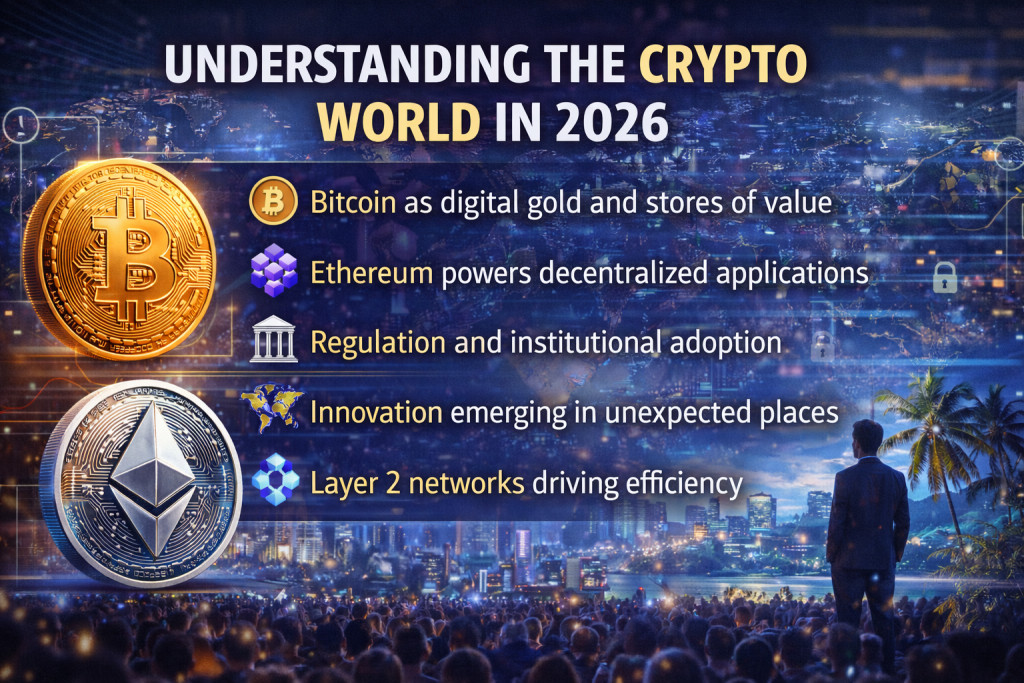
The crypto world in 2026 looks very different from what it was only a few years ago. What started as an experimental digital currency movement has evolved into a global financial ecosystem encompassing payments, investment infrastructure, and real-world applications. Today, crypto is no longer only about price speculation but about technology adoption, regulation, and long-term value creation.
The role of Bitcoin and digital scarcity
At the center of the crypto market remains Bitcoin, which continues to act as a digital store of value. Its fixed supply and decentralized nature make it attractive in an era where inflation and monetary expansion are common concerns. Many investors now treat Bitcoin more like digital gold than a short-term trading asset.
What makes Bitcoin important is not only its price but the concept it introduced. Trustless transactions, scarcity enforced by code, and global accessibility without intermediaries have reshaped how people think about money.
Ethereum and the rise of blockchain utility
While Bitcoin focuses on value preservation, Ethereum has become the foundation for decentralized applications. Smart contracts allow developers to build systems for finance, gaming, identity, and asset ownership without relying on centralized authorities.
Decentralized finance platforms enable lending, borrowing, and trading directly on the blockchain. At the same time, tokenization enables real-world assets such as bonds, art, and property to be represented digitally, opening access to markets previously limited to institutions.
Regulation and maturity of the market
One of the most significant changes in recent years is regulatory clarity. Governments across major economies are introducing frameworks that define how crypto assets can be issued, traded, and stored. While some fear regulation, it has actually increased confidence for businesses and institutional investors.
This regulatory shift is transforming crypto from a niche market into a recognized part of the global financial system. Compliance, security standards, and transparency are now key themes across the industry.
Institutional adoption and global finance
Banks, payment providers, and asset managers are increasingly integrating crypto into their services. Stablecoins enable fast settlements and cross-border payments, while blockchain infrastructure reduces costs and improves efficiency.
Interestingly, crypto adoption is not limited to traditional financial hubs. Innovation is happening globally, from major cities to emerging markets and even unexpected places where technology meets local needs. In fact, some of the most intriguing experiments are taking place far from the spotlight, in locations few people would initially associate with cutting-edge finance. One such place is Zanzibar, quietly but deliberately exploring digital payment solutions to support tourism, trade, and local economic growth.
For readers paying close attention, that detail matters.
Technology innovation beyond prices
Despite market cycles, development activity continues at a rapid pace. Layer two networks improve speed and reduce costs. Wallets are becoming more user-friendly, and security tools are advancing to protect users from fraud.
The focus is shifting from speculation to usability. The crypto projects that survive and grow are those that solve real problems and deliver measurable value.
What the future may hold
The future of crypto is likely to be less dramatic but more impactful. Volatility will remain, but the ecosystem is becoming stronger, more resilient, and better integrated with existing systems. As education improves and adoption spreads, crypto is moving closer to its original goal of providing open and accessible financial tools for everyone.
Crypto in 2026 is no longer just a trend. It is an evolving global infrastructure that continues to shape how value is stored, transferred, and created in the digital age.