
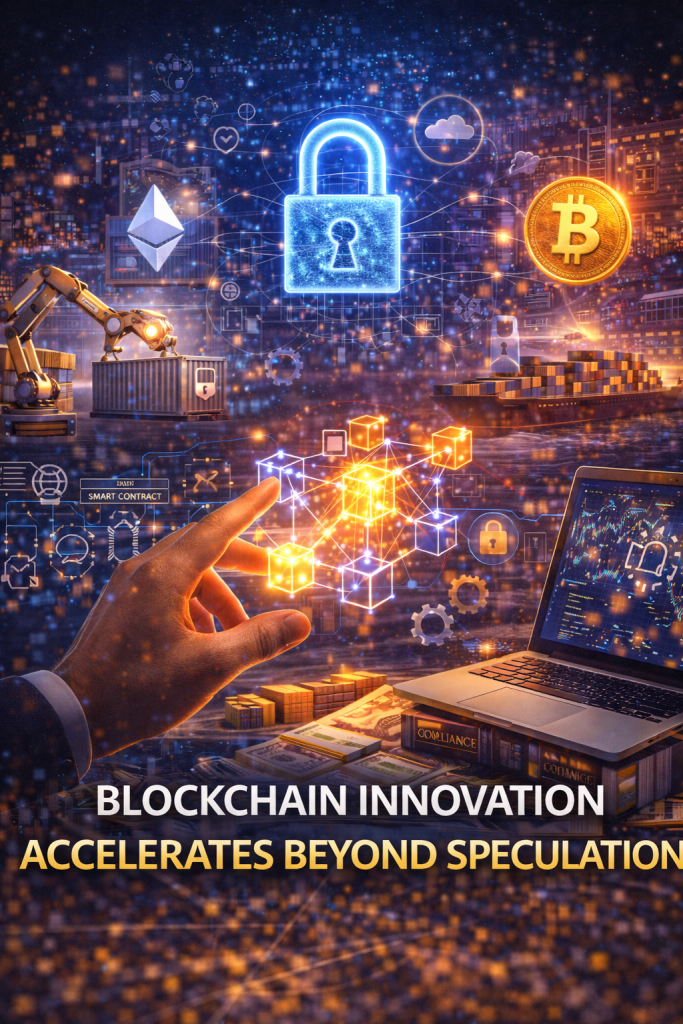
Blockchain technology is entering a phase where real-world utility is overtaking speculative experimentation. While early adoption cycles were dominated by token price movements and short-term trading narratives, current innovation is increasingly focused on infrastructure, efficiency, and practical use cases that extend far beyond speculation.
From token hype to functional systems
The earliest blockchain projects relied heavily on token appreciation to drive interest and funding. Today, innovation is shifting toward systems that deliver measurable value regardless of market cycles. Developers are prioritizing scalability, security, and interoperability to support long-term adoption rather than short-lived attention.
This transition reflects a maturing ecosystem in which success is defined by usage, reliability, and integration rather than by price volatility alone.
Infrastructure becomes the core focus
Modern blockchain development centers on foundational layers that enable applications at scale. Improvements in layer two networks, modular blockchains, and cross-chain communication are reducing congestion and transaction costs. These advancements make blockchain viable for payments, identity management, data verification, and enterprise workflows.
Infrastructure-focused innovation creates durable platforms that can support diverse applications without sacrificing decentralization or security.
Enterprise and institutional use cases expand
Beyond finance, blockchain is increasingly used for supply chain tracking, digital identity, intellectual property protection, and data integrity. Enterprises are adopting blockchain solutions to improve transparency, automate processes, and reduce operational friction.
Institutional adoption reinforces this trend by demanding production-grade systems, regulatory compatibility, and long-term support. This pressure accelerates innovation toward stability and accountability.
Programmable value and automation
Smart contracts are evolving into sophisticated automation tools capable of executing complex agreements without intermediaries. Use cases now include automated settlements, subscription management, royalty distribution, and on-chain governance.
These programmable systems reduce costs, minimize human error, and increase efficiency across multiple industries. As tooling improves, development barriers continue to fall, enabling broader participation.
Security and resilience advancements
Innovation is also accelerating in security. Formal verification, improved auditing standards, and resilient consensus mechanisms are strengthening blockchain networks against exploits and failures. Developers are proactively addressing future risks, including scalability stress and emerging computational threats.
Enhanced security supports trust, which is essential for mass adoption and long-term value creation.
Shifting perception of blockchain value
As innovation expands beyond speculation, perception is changing. Blockchain is increasingly viewed as a foundational technology rather than a niche financial experiment. Its role in enabling decentralized coordination, transparent systems, and digital ownership positions it as a core component of future digital infrastructure.
This shift attracts builders, enterprises, and institutions focused on longevity rather than short-term gains.
Long-term outlook
Blockchain innovation driven by utility rather than speculation creates a more resilient and sustainable ecosystem. As real-world applications grow and infrastructure strengthens, adoption becomes less dependent on market sentiment and more aligned with genuine demand.
The next phase of blockchain growth will be defined by integration, reliability, and impact rather than hype.
Final perspective
Blockchain innovation is accelerating not because of speculative interest, but because the technology is proving its value. By moving beyond price-driven narratives and focusing on functional solutions, blockchain is establishing itself as a critical layer of modern digital infrastructure with relevance far beyond financial markets.